LIBRO (2009).
MARTÍN SÁNCHEZ, Miguel Ángel: El imaginero Lorenzo Mercadante. Estudio de la obra y claves de su huella en la Virgen de las Nieves de la isla canaria de La Palma. Prólogo de Joaquín Yarza Luaces. Colección literaria Asphodel, núm 26. La Esperanza, Tenerife, 2009.
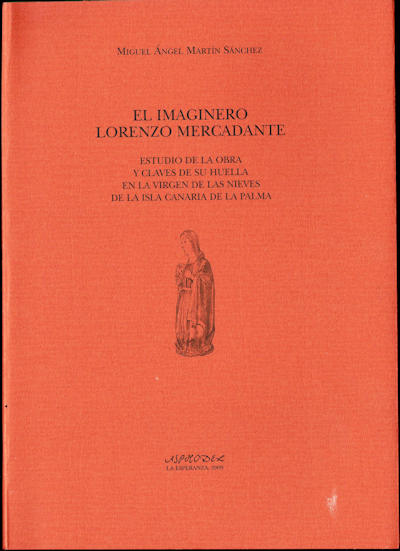 El libro El imaginero Lorenzo Mercadante. Estudio de la obra y claves de su huella en la Virgen de las Nieves de la isla canaria de La Palma es fruto de la relación intuida entre este imaginero medieval con una importante imagen de la isla de La Palma, su Virgen de las Nieves, una terracota policromadad (57 cm de alto), sobrevestida y enjoyada por la devoción popular desde hace más de tres siglos y de la que no está permitido, a día de hoy, conocer su interior cerámico, salvo su rostro (manos y niño son postizos de madera policromada). El hallazgo de unas fotos realizadas en 1964 sin ropajes, nunca publicadas permitió iniciar una tarea de búsqueda y cotejo de varios años que concluyó atribuyendo esta terracota al imaginero francés Lorenzo Mercadante de Bretaña, radicado en Sevilla en el siglo XV. Su gran aportación a la escultura se plasma de modo especial en la terracota, en la que se manifiesta maestro y que, directa o indirectamente, deja su impronta en Sevilla. Se sabía que había creado un modelo de Virgen con el Niño, un icono, un prototipo, y que con la ayuda de su taller repitió tantas veces como lo fueron exigiendo sus encargos. El presente trabajo, que se ofrece como la primera monografía que del escultor bretón se hace en nuestro país, consta de tres partes.
La primera brinda un estudio de carácter antropológico que acumula datos importantes para la historia del culto rendido a la Virgen de Las Nieves en la isla palmera. Nos planteamos nuevas preguntas sobre la función que se le asigna en la evangelización de la isla. Se hace especial hincapié en el transvase de un culto indígena a otro cristiano. Se intenta poner orden a las parcas descripciones literarias que de la imagen se ha hecho a lo largo del tiempo, y procedemos a una nueva descripción atendiendo a la información suministrada por las fotos de archivo, ahora encontradas, y al cotejo de las imágenes mercadantinas peninsulares. Se ha documentado una hipótesis acerca de su estado de conservación actual. Al final de esta parte se esbozan algunas particularidades del culto rendido. Su culto pasa inadvertido por parte de los principales cronistas de Canarias pero existen indicios para pensar que empieza a cobrar fuerza desde finales del XVI; no obstante, el éxito que alcanza se sitúa a mediados del siglo XVII, favorecido por los regidores de la isla, que se adueñan de su iglesia frente a los frailes dominicos que pretenden establecer allí una segunda fundación en la isla. Intereses de rentas eclesiásticas parecen explicar el fondo de las tensiones vividas.
La segunda está dedicada al artista, su origen, escuela de la que deriva y técnicas de las que se sirve. Entre 1454 y 1468 se ha documentado la actividad de Mercadante en Sevilla. Lleva su firma el Sepulcro del Cardenal don Juan de Cervantes (1454-1458), y a él se atribuye la Virgen del Madroño (1454). Esculpidas en alabastro, ambos conjuntos se encuentran en el interior de la Catedral hispalense. El grueso de su producción lo componen las dos series de terracotas de las puertas del Bautismo y del Nacimiento (1464-67), adscritas al escultor desde 1911. A partir de 1926 empezaron a conocerse otros barros atribuidos al maestro; el último hallazgo en Sevilla data de 2004. Para el prologuista Joaquín Yarza, una de las aportaciones de este libro es el capítulo que se dedica a Un maestro del modelado: «A una formación “académica” [del autor del libro] se une un examen exhaustivo de la manera de trabajar de nuestro lejano y cercano y escultor».
La tercera despliega con minuciosas descripciones el catálogo de sus obras. Se reúne por primera vez el repertorio de terracotas policromadas que se le vienen atribuyendo desde 1926: trece iconos de la Virgen, cuatro santos varones, dos arcángeles miguelinos y una figura sedente de Dios Padre que en este estudio filiamos al imaginero y que constituye, según Yarza, «el primer catálogo que se haya hecho nunca». Aquí aparecen, junto a la escultura palmera, las trece terracotas policromadas de la Virgen con el Niño, localizadas todas ellas en el sur peninsular (Badajoz, Sevilla, Granada, Córdoba y Cádiz) y que se ajustan a un modelo único creado por Mercadante. Para esto, partimos de una nueva definición del esquema de la Virgen con el Niño formulado en piedra en 1454: la Virgen del Madroño y que, posteriormente, se versiona en catorce obras marianas de arcilla cocida. Se realiza un detenido estudio sobre el estado de la crítica artística: los autores que por primera vez dieron paternidad mercadantina para aquellas imágenes, sus ubicaciones pasadas y presentes, se actualizan medidas y descripciones formales; pero sobre todo, establecemos paralelismos, con el grueso de la obra de más certera atribución: portadas del Nacimiento y del Bautismo en la seo sevillana. A partir de este corpus se corroboran atribuciones que se venían haciendo desde la época de Manuel Gómez-Moreno y Diego Angulo Iñiguez y se apuntalan otras. Finalmente se establecen, de forma sistemática, los puntos de contacto entre aquellas andaluzas y nuestra pequeña Virgen de las Nieves canaria, para concluir aportando los datos que presumen la atribución de la pieza palmera, quedando así metodológicamente planteada y que, según Yarza, «a partir de este momento podemos considerar que pertenece al grupo de esculturas mercadantinas».
El libro lo abre un prólogo de Joaquín Yarza Luaces y contiene 414 pp. más XXXV láms. a todo color, con 48 dibujos de la obra de Mercadante, realizados para esta publicación por Sabina Gau.
Citas recibidas

The book “Lorenzo Mercadante, Image Maker. A Study of His Work and the Keys to His Influence on the Virgin of the Snows of the Canary Island of La Palma” is the result of the perceived connection between this medieval image maker and an important sculpture on the island of La Palma: its Virgin of the Snows, a polychrome terracotta (57 cm high), clothed and adorned with jewelry through popular devotion for more than three centuries. To this day, it is not permitted to examine its ceramic interior, except for its face (the hands and the Child are later additions made of polychrome wood). The discovery of photographs taken in 1964 showing the figure without its garments, never before published, made it possible to begin several years of research and comparison, ultimately leading to the attribution of this terracotta to the French sculptor Lorenzo Mercadante of Brittany, who settled in fifteenth-century Seville. His great contribution to sculpture is expressed especially through terracotta, a medium in which he proved himself a master and through which, directly or indirectly, he left his mark on Seville. It was already known that he had created a model of the Virgin and Child—an icon, a prototype—which, with the help of his workshop, he reproduced as many times as required by his commissions. This work, presented as the first monograph on the Breton sculptor published in our country, is divided into three parts.
The first provides an anthropological study that compiles important data for the history of the veneration of the Virgin of the Snows on the island of La Palma. It raises new questions about the role assigned to her in the evangelization of the island. Special emphasis is placed on the transfer of an indigenous cult to a Christian one. An attempt is made to bring order to the scant literary descriptions that have been made of the image over time, and a new description is presented based on information provided by newly discovered archival photographs and through comparison with Mercadante-style images from the Iberian Peninsula. A hypothesis regarding its current state of preservation has also been documented. At the end of this section, some distinctive features of the devotion paid to her are outlined. Her cult goes largely unnoticed by the principal chroniclers of the Canary Islands, but there is evidence to suggest that it began to gain strength from the late sixteenth century onward. Nevertheless, the success it achieved dates to the mid-seventeenth century, promoted by the island's councilors, who took control of her church in opposition to the Dominican friars, who sought to establish a second foundation there on the island. Conflicts over ecclesiastical revenues appear to explain the underlying tensions that arose.
The second is dedicated to the artist, his origin, the school from which he emerged, and the techniques he employed. Mercadante's activity in Seville has been documented between 1454 and 1468. The Tomb of Cardinal Don Juan de Cervantes (1454–1458) bears his signature, and the Virgin of the Strawberry Tree (1454) is attributed to him. Sculpted in alabaster, both works are located inside Seville Cathedral. The bulk of his production consists of the two series of terracotta sculptures for the Baptism and Nativity doors (1464–67), attributed to the sculptor since 1911. From 1926 onward, other terracotta works attributed to the master began to come to light; the most recent discovery in Seville dates from 2004. According to the prologue writer, Joaquín Yarza, one of the contributions of this book is the chapter devoted to “A Master of Modeling”: “An ‘academic’ training [on the part of the book’s author] is combined with an exhaustive examination of the way our distant yet familiar sculptor worked.”
The third presents, with meticulous descriptions, the catalog of his works. It brings together for the first time the repertoire of polychrome terracottas that have been attributed to him since 1926: thirteen icons of the Virgin, four male saints, two archangels named Michael, and a seated figure of God the Father, which in this study we attribute to the sculptor and which, according to Yarza, constitutes “the first catalog ever made.” Here, alongside the sculpture from La Palma, appear the thirteen polychrome terracottas of the Virgin and Child, all located in southern Spain (Badajoz, Seville, Granada, Córdoba, and Cádiz), and all conforming to a single model created by Mercadante. To achieve this, we begin with a new definition of the Virgin and Child scheme formulated in stone in 1454: the Virgin of the Strawberry Tree, which was later reinterpreted in fourteen Marian works made of fired clay. A thorough study is carried out on the state of artistic criticism: the authors who first attributed those images to Mercadante, their past and present locations, and updated measurements and formal descriptions; but above all, we establish parallels with the bulk of the works whose attribution is most certain: the portals of the Nativity and the Baptism in Seville Cathedral. Based on this corpus, we confirm attributions that had been proposed since the time of Manuel Gómez-Moreno and Diego Angulo Iñiguez and reinforce others. Finally, the points of contact between those Andalusian works and our small Canarian Virgin of the Snows are established systematically, concluding with the evidence supporting the attribution of the La Palma piece. Thus, the attribution is methodologically established and, according to Yarza, “from this moment onward we may consider that it belongs to the group of Mercadante’s sculptures.”
The book opens with a prologue by Joaquín Yarza Luaces and contains 414 pages plus XXXV full-color plates, featuring 48 drawings of Mercadante’s work, produced for this publication by Sabina Gau.

Das Buch «Der Bildhauer Lorenzo Mercadante. Eine Untersuchung seines Werks und der Spuren, die er bei der Virgen de las Nieves auf der Kanarischen Insel La Palma hinterlassen hat» ist das Ergebnis der vermuteten Verbindung zwischen diesem mittelalterlichen Bildhauer und einer bedeutenden Figur der Insel La Palma, ihrer Virgen de las Nieves, einer polychromen Terrakottafigur (57 cm hoch), die seit mehr als drei Jahrhunderten durch die Volksfrömmigkeit mit Gewändern bekleidet und mit Schmuck verziert wird und von der es bis heute nicht gestattet ist, ihr keramisches Inneres zu erkennen, mit Ausnahme ihres Gesichts (Hände und Kind sind unecht aus polychromem Holz). Die Entdeckung einiger 1964 aufgenommener, nie veröffentlichter Fotos ohne Gewänder ermöglichte den Beginn einer mehrjährigen Recherche- und Vergleichsarbeit, die schliesslich dazu führte, dass diese Terrakotta dem französischen Bildhauer Lorenzo Mercadante aus der Bretagne zugeschrieben wurde, der im 15. Jahrhundert in Sevilla ansässig war. Sein grosser Beitrag zur Bildhauerkunst kommt besonders in der Terrakotta zum Ausdruck, in der er sich als Meister erweist und die direkt oder indirekt ihre Spuren in Sevilla hinterliess. Es war bekannt, dass er ein Modell der Jungfrau mit dem Kind geschaffen hatte – eine Ikone, einen Prototyp –, und dass er dieses mit Hilfe seiner Werkstatt so oft nachbildete, wie es seine Aufträge erforderten. Die vorliegende Arbeit, die als erste Monografie über den bretonischen Bildhauer in unserem Land erscheint, besteht aus drei Teilen.
Die erste Arbeit bietet eine anthropologische Studie, die wichtige Daten zur Geschichte der Verehrung der Virgen de las Nieves auf der Insel La Palma liefert. Wir stellen neue Fragen zur Rolle, die ihr bei der Evangelisierung der Insel zukommt. Besonderes Augenmerk wird auf den Übergang von einem indigenen Kult zu einem christlichen gelegt. Es wird versucht, Ordnung in die spärlichen literarischen Beschreibungen zu bringen, die im Laufe der Zeit über das Bildnis verfasst wurden, und wir erstellen eine neue Beschreibung unter Berücksichtigung der Informationen aus den nun aufgefundenen Archivfotos sowie durch den Abgleich mit den auf dem Festland verbreiteten Handelsbildern. Es wurde eine Hypothese über den aktuellen Erhaltungszustand des Bildnisses aufgestellt. Am Ende dieses Abschnitts werden einige Besonderheiten des ihr gewidmeten Kultes skizziert. Ihr Kult bleibt von den wichtigsten Chronisten der Kanarischen Inseln unbeachtet, doch gibt es Anzeichen dafür, dass er ab Ende des 16. Jahrhunderts an Bedeutung gewinnt; seinen Höhepunkt erreicht er jedoch Mitte des 17. Jahrhunderts, begünstigt durch die Ratsherren der Insel, die sich ihre Kirche gegen die Dominikanermönche aneignen, welche dort eine zweite Niederlassung auf der Insel errichten wollen. Interessen an kirchlichen Einkünften scheinen den Hintergrund dieser Spannungen zu erklären.
Der zweite Teil ist dem Künstler gewidmet, seiner Herkunft, der Schule, aus der er stammt, und den Techniken, die er anwendet. Zwischen 1454 und 1468 ist Mercadantes Tätigkeit in Sevilla dokumentiert. Das Grabmal des Kardinals Don Juan de Cervantes (1454–1458) trägt seine Signatur, und ihm wird die Virgen del Madroño (1454) zugeschrieben. Beide aus Alabaster gehauenen Ensembles befinden sich im Inneren der Kathedrale von Sevilla. Den Grossteil seines Schaffens bilden die beiden Terrakotta-Serien an den Türen der Taufkapelle und der Geburt (1464–67), die dem Bildhauer seit 1911 zugeschrieben werden. Ab 1926 wurden weitere dem Meister zugeschriebene Terrakotta-Arbeiten bekannt; der letzte Fund in Sevilla stammt aus dem Jahr 2004. Für den Verfasser des Vorworts, Joaquín Yarza, ist eines der Highlights dieses Buches das Kapitel, das dem Thema «Ein Meister der Modellierung» gewidmet ist: «Zu einer ‹akademischen› Ausbildung [des Autors des Buches] gesellt sich eine umfassende Untersuchung der Arbeitsweise unseres fernen und doch nahen Bildhauers».
Die dritte Ausstellung präsentiert mit detaillierten Beschreibungen den Katalog seiner Werke. Zum ersten Mal wird das Repertoire der polychromen Terrakotten zusammengestellt, die ihm seit 1926 zugeschrieben werden: dreizehn Ikonen der Jungfrau Maria, vier männliche Heilige, zwei Erzengel nach dem Vorbild des Michael und eine sitzende Figur von Gott dem Vater, die wir in dieser Studie dem Bildhauer zuordnen und die laut Yarza «den ersten Katalog darstellt, der je erstellt wurde». Hier erscheinen neben der Skulptur aus La Palma die dreizehn polychromen Terrakotten der Jungfrau mit dem Kind, die sich alle im Süden der Halbinsel befinden (Badajoz, Sevilla, Granada, Córdoba und Cádiz) und einem von Mercadante geschaffenen einheitlichen Modell entsprechen. Als Ausgangspunkt dient uns dabei eine neue Definition der 1454 in Stein gemeisselten Arbei der Jungfrau mit dem Kind: die Virgen del Madroño, die später in vierzehn marianischen Werken aus gebranntem Ton variiert wurde. Es wird eine eingehende Untersuchung des Stands der Kunstkritik durchgeführt: Die Autoren, die diesen Darstellungen erstmals Mercadante als Schöpfer zuschrieben, sowie deren frühere und heutige Standorte werden berücksichtigt, Masse und formale Beschreibungen werden aktualisiert; vor allem aber stellen wir Parallelen zum Grossteil des Werks her, dessen Zuschreibung am sichersten ist: die Portale der Geburt und der Taufe in der Kathedrale von Sevilla. Anhand dieses Korpus werden Zuschreibungen bestätigt, die bereits seit der Zeit von Manuel Gómez-Moreno und Diego Angulo Iñiguez vorgenommen wurden, und andere werden untermauert. Schliesslich werden systematisch die Gemeinsamkeiten zwischen den andalusischen Skulpturen und unserer kleinen kanarischen «Virgen de las Nieves» herausgearbeitet, um schliesslich die Daten anzuführen, die für die Zuordnung des Werkes aus La Palma sprechen, womit die methodische Grundlage geschaffen ist und man laut Yarza «ab diesem Zeitpunkt davon ausgehen kann, dass es zur Gruppe der Mercadante-Skulpturen gehört».
Das Buch beginnt mit einem Vorwort von Joaquín Yarza Luaces und umfasst 414 Seiten sowie XXXV vollfarbige Tafeln mit 48 Zeichnungen von Mercadantes Werk, die Sabina Gau speziell für diese Publikation angefertigt hat.